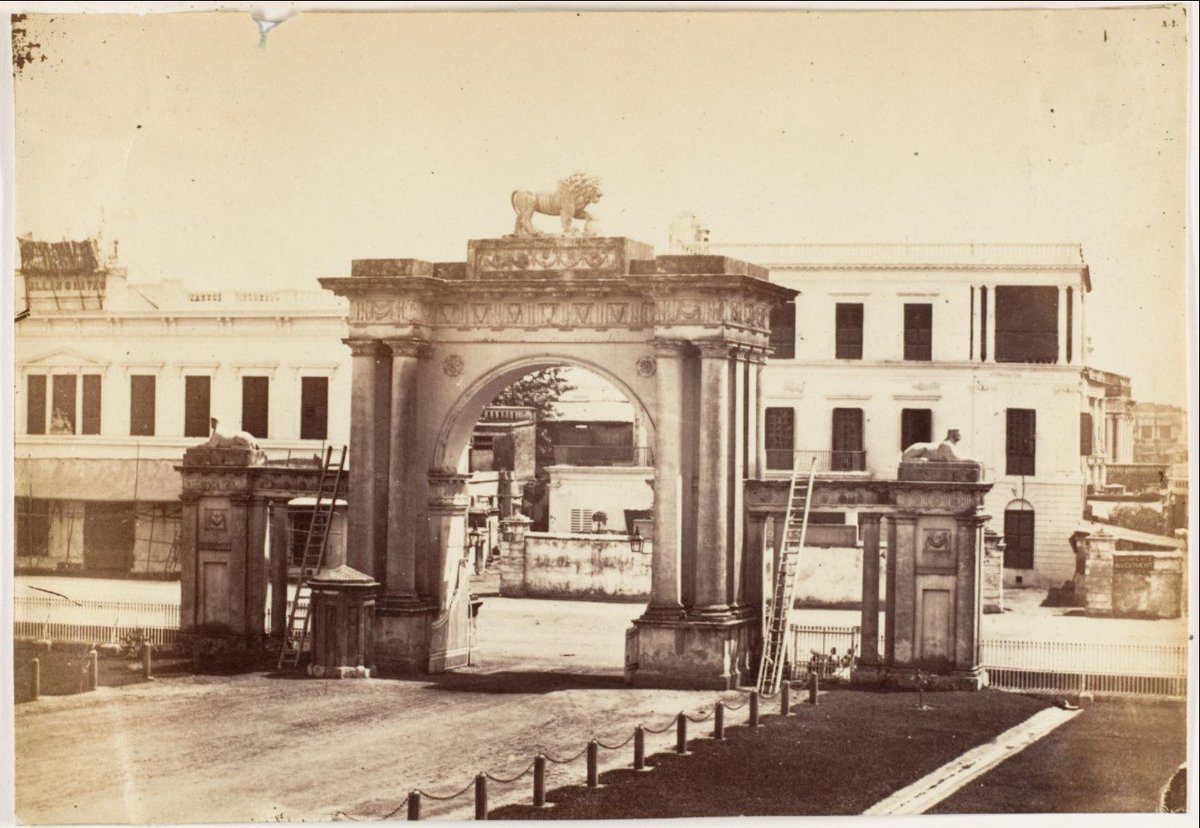
Raja Nand Kumar was hanged today i.e. on 5th August in 1775.
Raja Nand Kumar, a Hindu Brahmin was a big Zamindar and a very influential person of Bengal. He was loyal to the English company ever since the days of Clive and was popularly known as “black colonel” by the company. Three out of four members of the council were opponents of Hastings, the Governor-General and thus the council consisted of two distinct rival groups, the majority group being opposed to Hastings. The majority group comprising Francis, Clavering and Monson instigated Nand Kumar to bring certain charges of bribery and corruption against warren Hastings before the council whereupon Nand Kumar in march, 1775 gave a latter to Francis, one of the members of the council complaining that in 1772, Hastings accepted from him bribery of more than one Lakh for appointing his son Gurudas, as Diwan. The letter also contained an allegation against Hastings that he accepted rupees two and a half lakh from Munni begum as bribe for appointing her as the guardian of the minor Nawab Mubarak-ud-Daulah. Francis placed his letter before the council in his meeting and other supporter, monsoon moved a motion that Nand Kumar should be summoned to appear before the Council.
Warren Hastings who was presiding the meeting in the capacity of Governor-General, opposed Monson’s motion on the ground that he shall not sit in the meeting to hear accusation s against himself nor shall he acknowledge the members of his council to be his judges. Mr. Barwell ,the alone supporter member of Hastings ,put forth a suggestion that Nand Kumar should file his complaint in the supreme court because it was the court and not the council ,which was competent to hear the case. But Monson’s motion was supported by the majority hence Hastings dissolved the meeting. Thereupon majority of the members objected to this action of Hastings and elected Clavering to preside over the meeting in place of Hastings .
Nand Kumar was called before the council to prove his charges against Hastings. The majority members of the council examined Nand Kumar briefly and declared that the charges leveled against Hastings were proved and directed Hastings to deposit an amount of Rs.3, 54,105 in treasury of the company, which he had accepted as a bribe from Nand Kumar and Munni Begum. Hastings genuinely believed that the council had no authority to inquire into Nand Kumar’s charges against him.
This event made Hastings a bitter enemy of Nand Kumar and he looked for an opportunity to show him down.
Facts of the case:- Soon after, Nand Kumar was along with Fawkes and Radha Charan were charged and arrested for conspiracy at the instance of Hastings and barwell.
In order to bring further disgrace to Raja Nand Kumar, Hastings manipulated another case of forgery against him at the instance of one Mohan Prasad in the conspiracy case. The Supreme Court in its decision of July 1775 fined Fawkes but reserved its judgment against Nand Kumar on the grounds of pending fraud case. The charge against Nand Kumar in the forgery case was that he had forged a bond in 1770. The council protested against Nand Kumar’s charge in the Supreme Court but the Supreme Court proceeded with the case unheeded.
Finally, Nand Kumar was tried by the jury of twelve Englishmen who returned a verdict of ‘guilty’ and consequently, the supreme court sentenced him to death under an act of the British parliament called the Forgery Act which was passed as early as 1728. Serious efforts were made to save the life of Nand Kumar and an application for granting leave to appeal to the king-in-council was moved in the Supreme Court but the same was rejected. Another petition for recommending the case for mercy to the British council was also turned down by the Supreme Court. The sentence passed by the Supreme Court was duly executed by hanging Nand Kumar to death on August 5, 1775.
In this way, Hastings succeeded in getting rid of Nand Kumar.
With thanks to: http://www.lawyersclubindia.com